
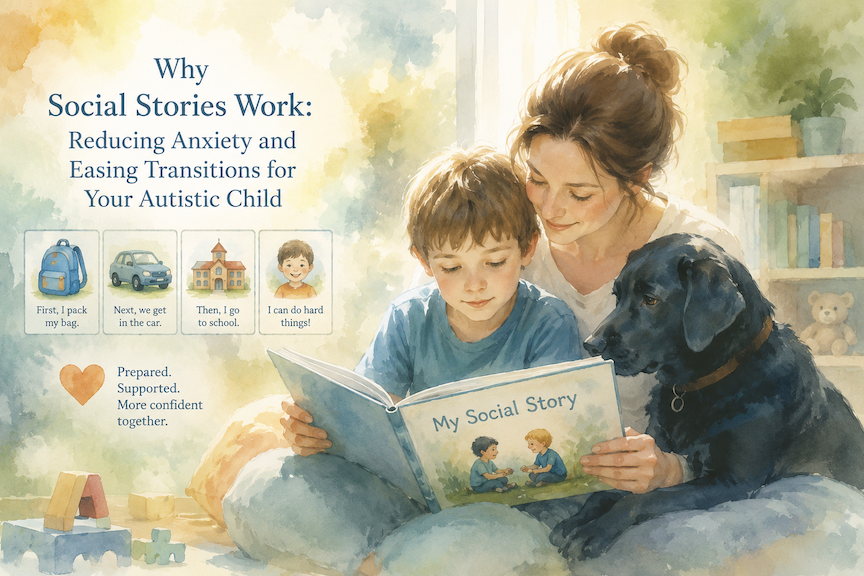
Why Social Stories Work: Reducing Anxiety and Easing Transitions for Your Autistic Child
It’s 7:45 a.m. Backpack: on. Shoes: half-on. And your child is on the floor, sobbing, because today the bus is coming five minutes earlier for a “special schedule” nobody warned them about. You didn’t do anything wrong. Your child didn’t do anything wrong. The world just handed them an unexpected change, and their nervous system responded exactly the way it’s wired to.
If this scene feels familiar, take a breath — you’re not failing, and your child isn’t being “difficult.” What’s happening is very human, very common in autism, and very fixable with the right tool. That tool is the **social story**, and it’s one of the most well-researched, gentle ways to reduce anxiety and ease transitions for autistic children.
### What Is a Social Story, Really?
A social story is a short, simple narrative that describes a situation, event, or skill from your child’s point of view. It answers the questions swirling in their mind before they even know how to ask them: *What’s going to happen? Why? Who will be there? What am I supposed to do? How will it end?*
This approach was developed by educator Carol Gray in the early 1990s, and it remains one of the most widely used and studied strategies in autism support today. Unlike a lecture or a list of rules, a good social story is written *with* the child in mind — patient, positive, and specific to their world.
### The Science Behind the Calm
Research on autism consistently points to a few key truths that explain why social stories are so effective:
– **Predictability lowers anxiety.** Many autistic children experience the unknown as genuinely threatening — not because they’re overreacting, but because uncertainty is harder for the brain to process without a clear script. A social story fills in the blanks *before* the event happens.
– **Visual and narrative processing are often strengths.** Many autistic learners process sequenced, concrete information more easily than abstract verbal instructions. Stories work with the brain, not against it.
– **Rehearsal reduces in-the-moment overwhelm.** Reading a story ahead of time is like a mental dress rehearsal. By the time the real event arrives, it already feels a little familiar.
– **Positive framing builds confidence, not just compliance.** Social stories aren’t about controlling behavior — they’re about helping a child understand their world well enough to feel safe in it.
### Where Social Stories Shine: Everyday Transitions
Social stories are especially powerful for the moments that tend to spark the biggest struggles:
– School drop-off and pickup routines
– Grocery store trips (crowds, checkout lines, unexpected item shortages)
– Doctor, dentist, or haircut appointments
– Fire drills or schedule changes
– Starting a new class, camp, or activity
– Holidays, travel, or houseguests
### Two Families, Two Stories
**Mateo, age 5, and the grocery store.** Mateo’s mom noticed that grocery trips almost always ended in tears near the checkout line — the noise, the wait, the “no” to a candy bar. Together, they used a personalized story titled “Mateo Goes to the Store,” walking through each step: parking, the cart, picking three items together, and what happens at checkout, including a friendly reminder that they might see candy but won’t buy it today. After a week of reading it before each trip, Mateo started narrating the steps himself in the car. The meltdowns didn’t disappear overnight, but they became shorter, and Mateo started to trust that he knew what was coming.
**Aaliyah, age 7, and school drop-off.** Aaliyah loved her teacher but dreaded the goodbye moment at the classroom door. Her story focused on one gentle idea: “When Mom says ‘see you later,’ it means she is coming back after school, just like every day.” Paired with a small visual schedule, the story helped Aaliyah’s drop-offs go from 15 minutes of tears to a quick hug and a wave.
### How to Write (or Choose) an Effective Social Story
If you’re crafting your own, a few guidelines make a big difference:
– **Use your child’s voice and perspective** (“I go to the doctor” rather than “You must go to the doctor”).
– **Favor descriptive sentences over directive ones.** Describe what typically happens rather than issuing commands.
– **Keep the tone calm, positive, and reassuring** — even when describing something tricky.
– **Answer the big questions:** where, when, who, what happens, and what’s expected of me.
– **Personalize it** with your child’s name, favorite characters, or comforting details.
– **Keep language simple** and matched to your child’s comprehension level.
### Making Social Stories Part of Your Routine
– Read the story *before* the event, in a calm moment — not in the middle of a meltdown.
– Repeat it across several days leading up to a big change.
– Pair it with a visual schedule or picture cues when possible.
– Let your child reread it as often as they want — repetition builds security.
– Celebrate afterward, even quietly: “You did it. That was a big one.”
**Visual Suggestions:**
1. *Insert an illustrated example of a social story page — a friendly child character with a backpack and a thought bubble showing the day’s steps.*
2. *A simple before/after graphic showing a child’s anxiety level dropping across “story read → event happens.”*
3. *An icon set representing common transitions: a grocery cart, a school bus, a dentist chair, a suitcase.*
4. *A mockup screenshot of the Story Pathways personalized story creation screen, showing a child’s name and favorite character being added.*
### Key Takeaways
– Social stories work by replacing uncertainty with a gentle, predictable script.
– They’re backed by decades of use and research in autism support.
– They shine brightest for transitions: school, errands, appointments, and change.
– The best stories are personal, positive, and repeated often.
You are not overreacting by wanting to prevent tomorrow’s meltdown before it starts — you’re doing exactly what a loving, attentive parent does. And you don’t have to write every story completely from scratch.
**Ready to see how a personalized story could support your child’s next transition?** Create your first personalized social story free with Story Pathways — tailored to your child’s world, favorite characters, and specific challenges, ready in minutes.
*A note from our team: Every family’s rhythm looks different, and there’s no single “right” way to use a social story. Start small, stay consistent, and trust that you know your child best — we’re just here to help you tell their story.*