by cobalt4 | Aug 5, 2026 | Uncategorized
Building Communication Bridges: Simple Speech Practice Strategies for Home
You ask your child, “Do you want milk or juice?” and you get silence, an echo of your own question, or a gesture toward the fridge. You’re not sure if they understood, if they’re processing, or if they simply don’t have the words yet — and the not-knowing is one of the hardest parts.
Communication looks different for every autistic child, and that’s okay. Whether your child is nonspeaking, uses a handful of words, speaks in full sentences but struggles with back-and-forth conversation, or communicates through an AAC device, there are gentle, evidence-based ways to support them right where they are — starting today, at home.
### Communication Is Bigger Than Speech
Before diving into strategies, it helps to widen the lens. Communication includes:
– Spoken words
– Gestures, pointing, and facial expressions
– Sign language
– Picture exchange systems (like PECS)
– AAC (augmentative and alternative communication) devices and apps
– Written or typed words
Research is clear: supporting *any* form of functional communication builds the neural and social foundations that speech, when it emerges, can build upon. There is no reputable evidence that AAC use delays or discourages spoken language — in fact, it often supports it.
### Core Principles Behind Effective Speech Practice
– **Follow your child’s lead.** Communication grows fastest when it’s built around what your child is already interested in, not what you’ve decided they should talk about.
– **Model, don’t demand.** Instead of “say ball,” try narrating naturally: “Ball! You want the ball. Rolling ball!” Modeling reduces pressure while still reinforcing language.
– **Pause and wait.** After you ask something or offer a choice, count silently to five before jumping in. Many children need extra processing time to respond.
– **Expand, don’t correct.** If your child says “car go,” respond with “Yes! The car is going fast!” rather than correcting grammar directly — this naturally models fuller language.
– **Make it functional.** Practice language your child can actually use to get what they want or need — this builds motivation far better than abstract drills.
### Everyday Speech Practice Strategies
– **Narrate daily routines.** Talk through what you’re doing during snack time, bath time, or getting dressed — this builds vocabulary in context.
– **Offer structured choices.** “Do you want the red cup or blue cup?” gives a clear, low-pressure opportunity to communicate.
– **Use songs and rhymes.** Repetitive, musical language is often easier to access and genuinely fun.
– **Read together interactively.** Pause on exciting pages and wait for your child to fill in a word, sound, or gesture.
– **Play turn-taking games.** Rolling a ball back and forth, stacking blocks in turns — these build the rhythm of conversation before words are even involved.
– **Celebrate every attempt.** A gesture, an approximation, an eye glance toward what they want — all of it is communication worth celebrating.
### A Real-Life Example
Four-year-old Sam communicated mostly through pulling his mom’s hand toward what he wanted. Rather than insisting on words, his speech therapist encouraged the family to pair every request with a simple model: pointing at the snack cabinet while saying “want cracker,” then handing Sam a picture card of a cracker to exchange. Within a few months, Sam began approximating “kah-kah” for cracker on his own — not because anyone demanded it, but because the language had been modeled consistently, without pressure, in moments that mattered to him.
### How Personalized Stories Support Communication Too
Social stories aren’t just for transitions — they’re also a gentle way to model language. A story about “asking for a snack” or “telling Mom I need a break” gives your child a script they can absorb at their own pace, then borrow from in real moments. Many families find that pairing a personalized story with real-life practice reinforces new words and phrases far more effectively than either strategy alone.
### What’s Coming to Story Pathways
We’re building a **speech practice module** designed to work hand-in-hand with personalized stories — so the same words and phrases your child is learning to recognize in their story can be practiced aloud, at their own pace, with gentle feedback. It’s designed to complement, not replace, the guidance of a licensed speech-language pathologist.
**Visual Suggestions:**
1. *Insert an illustration of a parent and child sitting face-to-face during a turn-taking game.*
2. *A simple visual showing the “wait time” concept — a parent pausing with a thought bubble counting to five.*
3. *A mockup of an AAC-style picture choice board (cup vs. juice, ball vs. book).*
4. *A preview graphic of the upcoming Story Pathways speech practice screen.*
### Key Takeaways
– Communication includes far more than spoken words — every mode counts.
– AAC and other supports build language rather than replacing it.
– Following your child’s interests and pausing for response time make a real difference.
– Small, consistent, low-pressure practice moments add up over time.
You don’t need perfect scripts or a speech therapy degree to support your child’s communication — you need patience, presence, and a willingness to celebrate the small “wins” that often go unnoticed by anyone but you.
**Start building your child’s communication toolkit today.** Create a free personalized social story to model a phrase your child is working on, and join the waitlist for our upcoming speech practice features, designed to reinforce real-world communication in a way that feels natural and encouraging.
*A note from our team: If you have concerns about your child’s communication development, a licensed speech-language pathologist can offer personalized guidance and support alongside the strategies here.*
by cobalt4 | Jul 30, 2026 | Uncategorized
Teaching Your Autistic Child to Read: Phonics Strategies That Actually Work
You’re sitting on the living room floor with a picture book, sounding out “c-a-t” for what feels like the hundredth time this month. Your child is looking at the ceiling fan. You wonder: *is this even sinking in? Am I doing this right?*
Here’s the reassuring truth: teaching reading to an autistic child isn’t about finding one secret trick — it’s about using the same evidence-based building blocks that work for all early readers, adapted thoughtfully to your child’s strengths. Let’s walk through what the science says, and how you can bring it home today.
### The “Big Five” of Reading — Explained Simply
Decades of literacy research, most notably summarized by the National Reading Panel, point to five core skills every child needs to become a confident reader:
– **Phonemic awareness** — hearing and playing with the individual sounds in words (the difference between “bat” and “bad”).
– **Phonics** — connecting those sounds to letters and letter patterns.
– **Fluency** — reading with accuracy, reasonable speed, and appropriate expression.
– **Vocabulary** — understanding what words mean.
– **Comprehension** — understanding the meaning of what’s been read as a whole.
These five pillars matter just as much for autistic children as for any other learner — but *how* we teach them often needs to shift.
### Why Phonics Instruction Sometimes Needs to Look Different
Many autistic children are strong visual learners and may respond better to explicit, systematic phonics instruction than to more incidental, “figure it out from context” approaches. Research on early literacy in autism suggests:
– **Direct, structured teaching tends to outperform incidental learning.** Clear rules (“this letter makes this sound”) are often easier to grasp than inferring patterns from stories alone.
– **Visual supports strengthen the sound-letter connection.** Letter tiles, color-coded sounds, and pictures paired with words all help.
– **Special interests are powerful entry points.** A child fascinated by trains may engage far more with phonics practice built around train vocabulary than generic flashcards.
– **Some autistic children hyperlexic** — meaning they can decode words early and accurately, sometimes before comprehension catches up. If this sounds like your child, the focus may need to shift toward meaning-making rather than decoding drills.
### Practical Phonics Strategies to Try at Home
– **Start with sounds, not letter names.** Practice the *sound* a letter makes (“mmm” for M) before worrying about naming the letter.
– **Use multisensory practice.** Trace letters in sand, shaving cream, or on a tablet while saying the sound aloud — engaging touch, sight, and hearing together.
– **Break words into small chunks.** Clap out syllables, or slide a finger under each sound in a word (“c…a…t”).
– **Follow their interests.** Build simple word lists or short stories around dinosaurs, space, or whatever lights them up.
– **Keep sessions short and positive.** Five focused, successful minutes beats twenty frustrating ones. End on a win.
– **Use repetition without redundancy.** Revisit the same sounds across different games, books, and contexts so the skill generalizes.
### A Real-Life Example
Six-year-old Priya loved dinosaurs but resisted every traditional flashcard drill her parents tried. Her mom started writing simple three-letter words using dinosaur names and pictures — “rex,” “t-rex roars,” pairing each sound with a growly noise Priya thought was hilarious. Within a few weeks, Priya was blending sounds on her own, motivated not by pressure but by genuine delight. The content changed; the science-backed method — explicit, multisensory, systematic phonics — stayed the same.
### What About Comprehension?
Decoding is only half the journey. To support comprehension:
– Pause while reading to ask simple, concrete questions (“What did the dog do?”).
– Use picture supports to reinforce meaning, not just decoding.
– Connect new vocabulary to real objects or experiences whenever possible.
– Reread favorite books — familiarity builds both confidence and comprehension.
### What’s Coming to Story Pathways
We know that many families are juggling reading practice alongside everything else on their plate — which is why **Story Pathways is expanding into a dedicated phonics training module**, designed specifically with autistic learners in mind. It will bring together:
– Systematic, explicit phonics lessons built on the “Big Five” framework
– Personalization based on your child’s interests (yes, dinosaurs included)
– Visual and multisensory supports built right into each lesson
– Bite-sized sessions designed to fit a five-minute window or a twenty-minute one
**Visual Suggestions:**
1. *Insert a graphic of the “Big Five” reading pillars as five connected building blocks.*
2. *A photo-style illustration of a child tracing a letter in sand or shaving cream.*
3. *A mockup of a phonics lesson screen personalized around a dinosaur theme.*
4. *A simple progress chart showing sounds mastered over several weeks.*
### Key Takeaways
– Reading rests on five research-backed pillars: phonemic awareness, phonics, fluency, vocabulary, and comprehension.
– Explicit, systematic, multisensory phonics instruction tends to work well for many autistic learners.
– Personal interests are a genuine teaching tool, not a distraction.
– Short, positive, consistent sessions beat long, pressured ones.
You don’t need a special education degree to help your child build early reading skills — you need patience, the right approach, and permission to make it playful. That ceiling fan they’re staring at? They’re probably still listening.
**Want extra support along the way?** Join the waitlist for our upcoming phonics training module, built on evidence-based literacy instruction and personalized to your child’s world — and start with a free personalized social story today to make reading time itself feel a little more predictable and calm.
*A note from our team: Every reading journey has its own pace. Whether your child is just learning letter sounds or already reading full sentences, growth is growth — and we’re building tools to meet your child exactly where they are.*
by cobalt4 | Jul 23, 2026 | Uncategorized
You’re Doing Better Than You Think: Caring for Yourself While Caring for Your Child
It’s 9 p.m. The dishes aren’t done, tomorrow’s therapy appointment needs rescheduling, and you’re replaying the moment at bedtime when you snapped a little more sharply than you meant to. If a quiet voice in your head keeps whispering *you’re not doing enough*, we want to say something clearly and sincerely: **you are doing so much more than you realize, and you deserve care too.**
Parenting an autistic child is a marathon made of thousands of small sprints — appointments, advocacy, sensory meltdowns, celebrations, paperwork, and the constant mental math of “what will help right now?” Burnout isn’t a sign of weakness. It’s a completely predictable response to sustained, high-effort caregiving. Let’s talk about what actually helps.
### Naming Parent Burnout Honestly
Research on caregiver wellbeing — including studies specific to parents of autistic children — consistently shows elevated stress levels compared to parents of neurotypical children, driven not by the child themselves, but by systemic factors: lack of support, difficulty accessing services, financial strain, and the emotional weight of advocacy. Recognizing this isn’t about excuses — it’s about accuracy. You are carrying a heavier logistical and emotional load than most parenting advice accounts for, and that matters.
Signs of burnout can include:
– Persistent exhaustion that sleep doesn’t fully fix
– Feeling emotionally numb or easily overwhelmed by small things
– Guilt that shows up no matter what you do
– Difficulty finding joy in moments that used to feel good
– A nagging sense of isolation, even surrounded by people
If several of these sound familiar, please know: this is common, it’s real, and it’s worth taking seriously — including talking to a doctor or therapist if it’s significantly affecting your daily life.
### The Power of Praise — For Your Child *and* For You
We talk a lot about celebrating a child’s small wins — the first successful transition, the new word, the calm grocery trip. That praise matters enormously; research on positive reinforcement shows that specific, genuine encouragement builds both skill and confidence far more effectively than criticism or correction.
But here’s what often gets missed: **you need that same encouragement too.** Parents rarely get a gold star for the meltdown they calmly worked through, the therapy insurance call they made on hold for 40 minutes, or the bedtime routine they held steady for the hundredth night in a row. So let this be said plainly:
– You navigating a hard moment without losing your patience? That’s a win.
– You trying a new strategy even when you were exhausted? That’s a win.
– You simply showing up again today, imperfectly? That’s a win.
### Practical Ways to Protect Your Own Energy
– **Lower the bar on “enough.”** One consistent strategy done imperfectly beats five perfect ones abandoned by Wednesday.
– **Build in tiny recovery moments.** Five minutes of quiet coffee, a short walk, a song in the car alone — these aren’t indulgences, they’re maintenance.
– **Let go of comparison.** Every autistic child’s path looks different; comparing your week to another family’s highlight reel rarely helps.
– **Ask for specific help.** “Can you take bedtime on Thursday?” is easier for others to say yes to than a vague “I need help.”
– **Track your own wins, too.** Just like charting your child’s progress, noticing your own small victories can shift your mindset over time.
– **Connect with other parents.** Whether online or in person, community with people who *get it* — without needing an explanation — can be deeply restorative.
### A Real-Life Example
After months of feeling like she was “failing” at consistency with her son’s evening routine, one mom started keeping a tiny note on her phone — just one line each night about something that went okay, even something small like “he brushed his teeth without a fight.” A month later, scrolling back through the list, she was stunned. The list was full. She hadn’t been failing at all — she’d simply been too tired to notice she was succeeding.
### How Story Pathways Is Designed With You in Mind
We built this platform because we believe supporting your child and supporting *you* go hand in hand. That’s why we’re developing a **robust parent feedback and praise system** — designed to:
– Celebrate your child’s milestones with warm, specific, encouraging language
– Highlight your own consistency and effort, not just outcomes
– Offer gentle, judgment-free check-ins on how you’re doing, not just your child
– Connect you with a broader community of parents on similar paths, as Story Pathways grows into the wider Autism Ascent family
**Visual Suggestions:**
1. *Insert a warm illustration of a tired but smiling parent sitting quietly with a cup of coffee, a small “you’re doing great” note nearby.*
2. *A simple graphic listing burnout signs, formatted gently — not clinically.*
3. *A mockup of an encouraging in-app message: “This week, you showed up for bedtime 6 out of 7 nights. That’s real consistency.”*
4. *An illustration of a small parent support community — icons of diverse families connected in a circle.*
### Key Takeaways
– Parent burnout is a common, valid, research-supported reality — not a personal failing.
– Praise and encouragement matter for parents just as much as for children.
– Small, protected moments of recovery genuinely add up over time.
– You don’t have to do this without support — community and the right tools can lighten the load.
If no one has told you today: you are doing a genuinely hard thing, and you are doing it with more love and effort than you’re giving yourself credit for.
**You deserve encouragement too.** Create your first free personalized social story for your child today, and keep an eye out for our upcoming parent feedback and praise features — built to remind you, on the hard days and the good ones, that you’re doing better than you think.
*A note from our team: If you’re feeling persistently overwhelmed, please reach out to a healthcare provider or counselor — caring for yourself isn’t optional, it’s part of caring well for your child.*
—
by cobalt4 | Jul 23, 2026 | Uncategorized
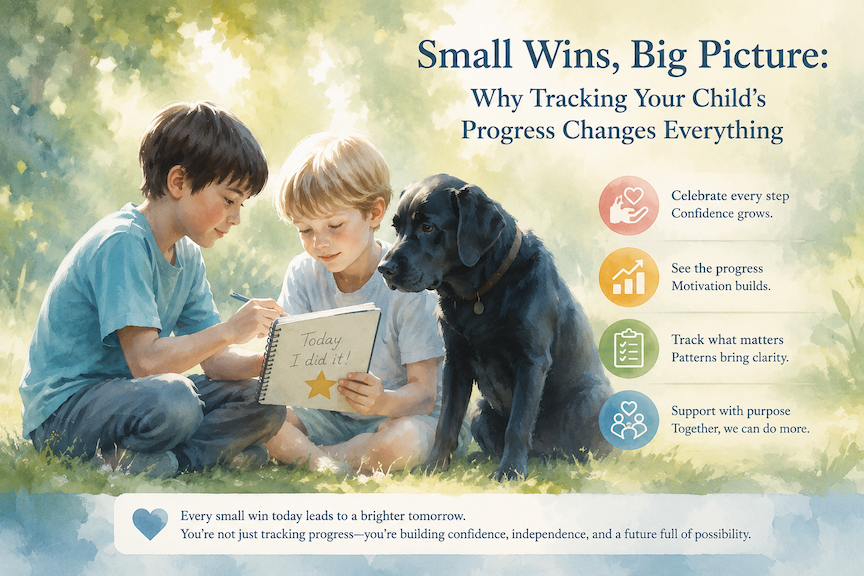
Small Wins, Big Picture: Why Tracking Your Child’s Progress Changes Everything
Some weeks feel like nothing is changing. Then, out of nowhere, your child says a new word, tolerates a transition without tears, or reads a whole sentence on their own — and you realize progress was happening all along. You just couldn’t see it in the day-to-day blur.
This is one of the most common and understandable struggles parents describe: growth in autism often happens gradually, unevenly, and quietly. Without a way to track it, it’s easy to feel discouraged, even when real progress is underway. That’s where simple, consistent monitoring can be a genuine game-changer — not just for your child’s development team, but for *you*.
### Why Tracking Progress Matters
Research on early intervention consistently shows that **data-informed approaches lead to better outcomes** — not because tracking creates progress, but because it reveals what’s actually working, so you can do more of it. Tracking helps you:
– **See patterns invisible in daily life.** A “bad week” might actually reflect steady growth with one difficult day, not backsliding.
– **Identify what’s actually helping.** Did a new social story reduce meltdowns at drop-off? Did a phonics game boost letter recognition? Data tells you.
– **Communicate more effectively with your child’s team.** Teachers, therapists, and doctors can act on specific, tracked information far more easily than a general “things seem better/worse.”
– **Protect your own morale.** On hard days, a simple chart showing three months of gains can be a powerful reminder: this is working, even when it doesn’t feel like it today.
### What to Track (Keep It Simple)
You don’t need a spreadsheet worthy of a research lab. Focus on a few meaningful, observable markers:
– **Social-emotional skills:** frequency of successful transitions, tolerance time during difficult moments, use of coping strategies
– **Communication:** new words or phrases used, successful requests made, AAC device usage
– **Literacy:** letters or sounds recognized, words decoded independently, minutes of engaged reading
– **Daily living or routine skills:** steps completed independently in a routine (e.g., getting dressed, brushing teeth)
### Simple Methods Any Parent Can Use
– **A basic tally.** A sticky note on the fridge with hash marks for “calm drop-offs this week” is genuinely valid data.
– **A weekly voice memo.** Thirty seconds describing a highlight or challenge, recorded consistently, becomes a rich record over months.
– **A shared notes app** with your partner, co-parent, or care team, logging brief daily observations.
– **A simple star or checkmark chart** your child can see and take pride in — visible progress can be motivating for kids too.
### A Real-Life Example
Jordan’s parents felt like grocery trips were “getting worse” — until they started jotting a quick note after each trip: how long it lasted, whether a meltdown occurred, and whether they’d used a social story beforehand. After six weeks, the pattern was clear: trips preceded by a story had a meltdown rate less than half of trips without one. That simple log didn’t just prove the strategy was working — it gave Jordan’s parents the confidence to keep going, even on the days it didn’t feel like progress.
### Turning Data Into Motivation, Not Pressure
A word of caution: tracking should energize you, not become another source of guilt. A few guardrails help:
– **Track trends, not daily perfection.** Look at the shape of the data over weeks, not any single tough day.
– **Celebrate small movement.** A meltdown that lasted 8 minutes instead of 20 is real progress, even if it’s not “solved.”
– **Involve your child when appropriate.** Age-appropriate charts and stickers can help kids feel proud of their own growth.
– **Share data with your team, not just yourself.** Bringing a simple log to therapy or school meetings often leads to more productive conversations.
### What’s Coming to Story Pathways
We’re building a **robust progress monitoring and charting system** designed to make this entire process effortless. Instead of sticky notes and scattered voice memos, families will be able to:
– Automatically track engagement with social stories, phonics activities, and speech practice
– View simple, visual charts showing growth over time across social-emotional, literacy, and communication milestones
– Receive gentle, encouraging summaries — “This month, three new words emerged during story time!” — rather than clinical data dumps
– Export simple progress reports to share with teachers and therapists
**Visual Suggestions:**
1. *Insert a mockup of a simple, colorful line chart showing “calm transitions per week” trending upward.*
2. *A sticky-note-style graphic showing a hand-tallied progress log, next to a polished digital version for contrast.*
3. *An illustration of a parent and child looking at a star chart together, both smiling.*
4. *A preview screenshot of the upcoming Story Pathways progress dashboard.*
### Key Takeaways
– Progress in autism is often gradual and easy to miss without simple tracking.
– You don’t need complex tools — a sticky note or voice memo is a valid start.
– Tracking should highlight trends and wins, not create pressure or perfection.
– Shared, visible data strengthens both your child’s care team and your own confidence.
You’re not imagining the hard days, and you’re not imagining the progress either — both are real, and both deserve to be seen clearly.
**Ready to see your child’s growth more clearly?** Start with a free personalized social story today, and join the waitlist for our upcoming progress tracking and charting features, designed to turn your daily efforts into a visible, encouraging picture of growth.
*A note from our team: Progress isn’t a straight line for any child — autistic or not. What matters most is the overall direction, and we’re honored to help you see it.*
by cobalt4 | Jul 17, 2026 | Uncategorized
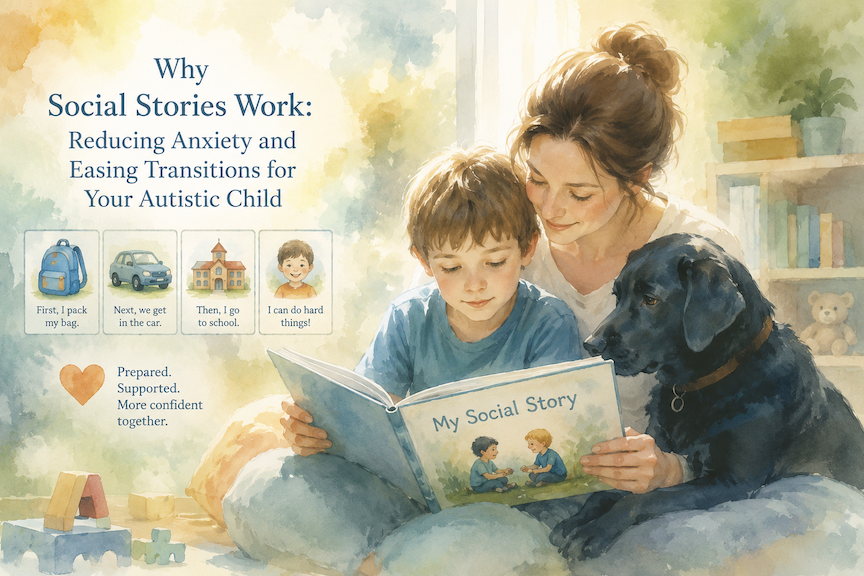
Why Social Stories Work: Reducing Anxiety and Easing Transitions for Your Autistic Child
It’s 7:45 a.m. Backpack: on. Shoes: half-on. And your child is on the floor, sobbing, because today the bus is coming five minutes earlier for a “special schedule” nobody warned them about. You didn’t do anything wrong. Your child didn’t do anything wrong. The world just handed them an unexpected change, and their nervous system responded exactly the way it’s wired to.
If this scene feels familiar, take a breath — you’re not failing, and your child isn’t being “difficult.” What’s happening is very human, very common in autism, and very fixable with the right tool. That tool is the **social story**, and it’s one of the most well-researched, gentle ways to reduce anxiety and ease transitions for autistic children.
### What Is a Social Story, Really?
A social story is a short, simple narrative that describes a situation, event, or skill from your child’s point of view. It answers the questions swirling in their mind before they even know how to ask them: *What’s going to happen? Why? Who will be there? What am I supposed to do? How will it end?*
This approach was developed by educator Carol Gray in the early 1990s, and it remains one of the most widely used and studied strategies in autism support today. Unlike a lecture or a list of rules, a good social story is written *with* the child in mind — patient, positive, and specific to their world.
### The Science Behind the Calm
Research on autism consistently points to a few key truths that explain why social stories are so effective:
– **Predictability lowers anxiety.** Many autistic children experience the unknown as genuinely threatening — not because they’re overreacting, but because uncertainty is harder for the brain to process without a clear script. A social story fills in the blanks *before* the event happens.
– **Visual and narrative processing are often strengths.** Many autistic learners process sequenced, concrete information more easily than abstract verbal instructions. Stories work with the brain, not against it.
– **Rehearsal reduces in-the-moment overwhelm.** Reading a story ahead of time is like a mental dress rehearsal. By the time the real event arrives, it already feels a little familiar.
– **Positive framing builds confidence, not just compliance.** Social stories aren’t about controlling behavior — they’re about helping a child understand their world well enough to feel safe in it.
### Where Social Stories Shine: Everyday Transitions
Social stories are especially powerful for the moments that tend to spark the biggest struggles:
– School drop-off and pickup routines
– Grocery store trips (crowds, checkout lines, unexpected item shortages)
– Doctor, dentist, or haircut appointments
– Fire drills or schedule changes
– Starting a new class, camp, or activity
– Holidays, travel, or houseguests
### Two Families, Two Stories
**Mateo, age 5, and the grocery store.** Mateo’s mom noticed that grocery trips almost always ended in tears near the checkout line — the noise, the wait, the “no” to a candy bar. Together, they used a personalized story titled “Mateo Goes to the Store,” walking through each step: parking, the cart, picking three items together, and what happens at checkout, including a friendly reminder that they might see candy but won’t buy it today. After a week of reading it before each trip, Mateo started narrating the steps himself in the car. The meltdowns didn’t disappear overnight, but they became shorter, and Mateo started to trust that he knew what was coming.
**Aaliyah, age 7, and school drop-off.** Aaliyah loved her teacher but dreaded the goodbye moment at the classroom door. Her story focused on one gentle idea: “When Mom says ‘see you later,’ it means she is coming back after school, just like every day.” Paired with a small visual schedule, the story helped Aaliyah’s drop-offs go from 15 minutes of tears to a quick hug and a wave.
### How to Write (or Choose) an Effective Social Story
If you’re crafting your own, a few guidelines make a big difference:
– **Use your child’s voice and perspective** (“I go to the doctor” rather than “You must go to the doctor”).
– **Favor descriptive sentences over directive ones.** Describe what typically happens rather than issuing commands.
– **Keep the tone calm, positive, and reassuring** — even when describing something tricky.
– **Answer the big questions:** where, when, who, what happens, and what’s expected of me.
– **Personalize it** with your child’s name, favorite characters, or comforting details.
– **Keep language simple** and matched to your child’s comprehension level.
### Making Social Stories Part of Your Routine
– Read the story *before* the event, in a calm moment — not in the middle of a meltdown.
– Repeat it across several days leading up to a big change.
– Pair it with a visual schedule or picture cues when possible.
– Let your child reread it as often as they want — repetition builds security.
– Celebrate afterward, even quietly: “You did it. That was a big one.”
**Visual Suggestions:**
1. *Insert an illustrated example of a social story page — a friendly child character with a backpack and a thought bubble showing the day’s steps.*
2. *A simple before/after graphic showing a child’s anxiety level dropping across “story read → event happens.”*
3. *An icon set representing common transitions: a grocery cart, a school bus, a dentist chair, a suitcase.*
4. *A mockup screenshot of the Story Pathways personalized story creation screen, showing a child’s name and favorite character being added.*
### Key Takeaways
– Social stories work by replacing uncertainty with a gentle, predictable script.
– They’re backed by decades of use and research in autism support.
– They shine brightest for transitions: school, errands, appointments, and change.
– The best stories are personal, positive, and repeated often.
You are not overreacting by wanting to prevent tomorrow’s meltdown before it starts — you’re doing exactly what a loving, attentive parent does. And you don’t have to write every story completely from scratch.
**Ready to see how a personalized story could support your child’s next transition?** Create your first personalized social story free with Story Pathways — tailored to your child’s world, favorite characters, and specific challenges, ready in minutes.
*A note from our team: Every family’s rhythm looks different, and there’s no single “right” way to use a social story. Start small, stay consistent, and trust that you know your child best — we’re just here to help you tell their story.*