
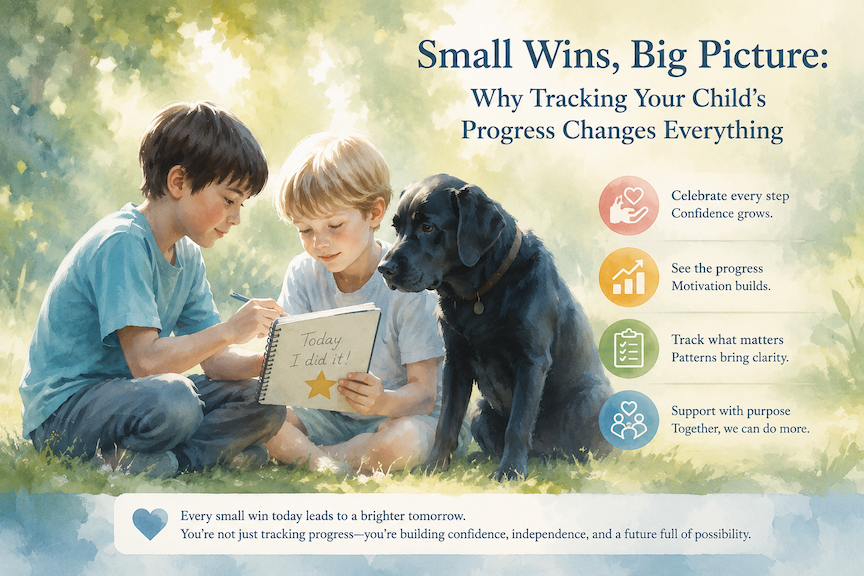
Small Wins, Big Picture: Why Tracking Your Child’s Progress Changes Everything
Some weeks feel like nothing is changing. Then, out of nowhere, your child says a new word, tolerates a transition without tears, or reads a whole sentence on their own — and you realize progress was happening all along. You just couldn’t see it in the day-to-day blur.
This is one of the most common and understandable struggles parents describe: growth in autism often happens gradually, unevenly, and quietly. Without a way to track it, it’s easy to feel discouraged, even when real progress is underway. That’s where simple, consistent monitoring can be a genuine game-changer — not just for your child’s development team, but for *you*.
### Why Tracking Progress Matters
Research on early intervention consistently shows that **data-informed approaches lead to better outcomes** — not because tracking creates progress, but because it reveals what’s actually working, so you can do more of it. Tracking helps you:
– **See patterns invisible in daily life.** A “bad week” might actually reflect steady growth with one difficult day, not backsliding.
– **Identify what’s actually helping.** Did a new social story reduce meltdowns at drop-off? Did a phonics game boost letter recognition? Data tells you.
– **Communicate more effectively with your child’s team.** Teachers, therapists, and doctors can act on specific, tracked information far more easily than a general “things seem better/worse.”
– **Protect your own morale.** On hard days, a simple chart showing three months of gains can be a powerful reminder: this is working, even when it doesn’t feel like it today.
### What to Track (Keep It Simple)
You don’t need a spreadsheet worthy of a research lab. Focus on a few meaningful, observable markers:
– **Social-emotional skills:** frequency of successful transitions, tolerance time during difficult moments, use of coping strategies
– **Communication:** new words or phrases used, successful requests made, AAC device usage
– **Literacy:** letters or sounds recognized, words decoded independently, minutes of engaged reading
– **Daily living or routine skills:** steps completed independently in a routine (e.g., getting dressed, brushing teeth)
### Simple Methods Any Parent Can Use
– **A basic tally.** A sticky note on the fridge with hash marks for “calm drop-offs this week” is genuinely valid data.
– **A weekly voice memo.** Thirty seconds describing a highlight or challenge, recorded consistently, becomes a rich record over months.
– **A shared notes app** with your partner, co-parent, or care team, logging brief daily observations.
– **A simple star or checkmark chart** your child can see and take pride in — visible progress can be motivating for kids too.
### A Real-Life Example
Jordan’s parents felt like grocery trips were “getting worse” — until they started jotting a quick note after each trip: how long it lasted, whether a meltdown occurred, and whether they’d used a social story beforehand. After six weeks, the pattern was clear: trips preceded by a story had a meltdown rate less than half of trips without one. That simple log didn’t just prove the strategy was working — it gave Jordan’s parents the confidence to keep going, even on the days it didn’t feel like progress.
### Turning Data Into Motivation, Not Pressure
A word of caution: tracking should energize you, not become another source of guilt. A few guardrails help:
– **Track trends, not daily perfection.** Look at the shape of the data over weeks, not any single tough day.
– **Celebrate small movement.** A meltdown that lasted 8 minutes instead of 20 is real progress, even if it’s not “solved.”
– **Involve your child when appropriate.** Age-appropriate charts and stickers can help kids feel proud of their own growth.
– **Share data with your team, not just yourself.** Bringing a simple log to therapy or school meetings often leads to more productive conversations.
### What’s Coming to Story Pathways
We’re building a **robust progress monitoring and charting system** designed to make this entire process effortless. Instead of sticky notes and scattered voice memos, families will be able to:
– Automatically track engagement with social stories, phonics activities, and speech practice
– View simple, visual charts showing growth over time across social-emotional, literacy, and communication milestones
– Receive gentle, encouraging summaries — “This month, three new words emerged during story time!” — rather than clinical data dumps
– Export simple progress reports to share with teachers and therapists
**Visual Suggestions:**
1. *Insert a mockup of a simple, colorful line chart showing “calm transitions per week” trending upward.*
2. *A sticky-note-style graphic showing a hand-tallied progress log, next to a polished digital version for contrast.*
3. *An illustration of a parent and child looking at a star chart together, both smiling.*
4. *A preview screenshot of the upcoming Story Pathways progress dashboard.*
### Key Takeaways
– Progress in autism is often gradual and easy to miss without simple tracking.
– You don’t need complex tools — a sticky note or voice memo is a valid start.
– Tracking should highlight trends and wins, not create pressure or perfection.
– Shared, visible data strengthens both your child’s care team and your own confidence.
You’re not imagining the hard days, and you’re not imagining the progress either — both are real, and both deserve to be seen clearly.
**Ready to see your child’s growth more clearly?** Start with a free personalized social story today, and join the waitlist for our upcoming progress tracking and charting features, designed to turn your daily efforts into a visible, encouraging picture of growth.
*A note from our team: Progress isn’t a straight line for any child — autistic or not. What matters most is the overall direction, and we’re honored to help you see it.*